
If your glasses prescription keeps changing year after year, keratoconus may be the reason. This progressive eye condition causes the cornea to gradually thin and bulge outward, shifting your vision in ways that corrective lenses can only partially address. The good news is that a procedure called corneal crosslinking (CXL) is specifically designed to stop that progression.
Keep reading to learn more about corneal crosslinking, how it can benefit patients with keratoconus, and whether it could be right for you.
What Is Keratoconus?
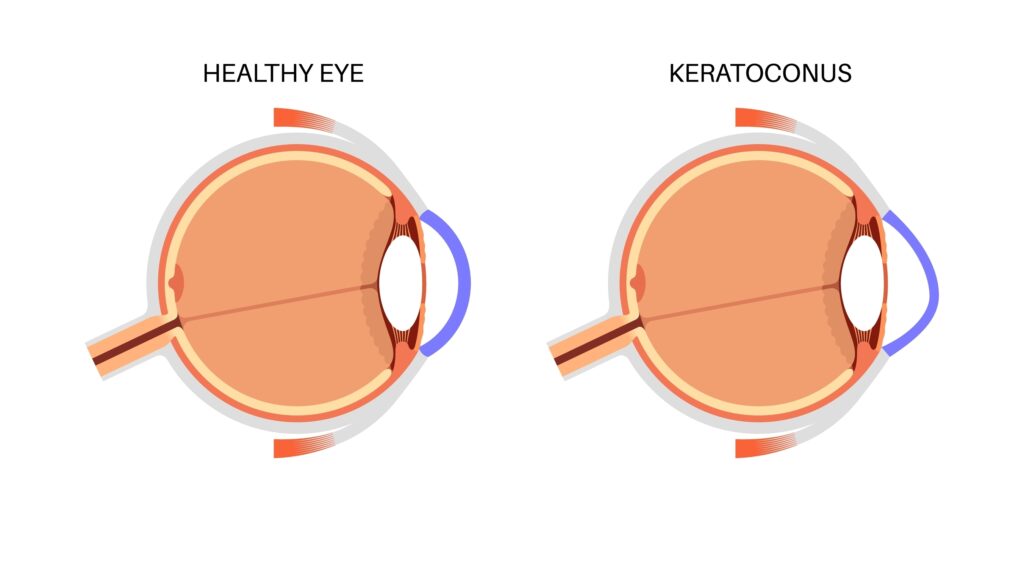
The cornea is the clear, dome-shaped front surface of your eye. In a healthy eye, it maintains a round, stable shape that allows light to focus precisely on the retina.
With keratoconus, the structural proteins that hold the cornea together weaken over time. As they do, the cornea gradually thins and bulges forward into a more cone-like shape.
This shift affects how light enters the eye, making vision increasingly difficult to correct. Patients often notice blurry or distorted vision, heightened sensitivity to light and glare, and a pattern of prescription changes that seem to happen faster than expected.
For some people, updated glasses or specialty contact lenses can manage symptoms reasonably well. However, because keratoconus is progressive, managing symptoms alone doesn’t address the underlying structural changes.
How Corneal Crosslinking Can Help
The cornea’s shape and strength depend on a network of collagen fibers layered throughout its tissue. In a healthy cornea, those fibers are tightly bonded and well-organized.
Keratoconus disrupts those bonds, allowing the cornea to weaken and deform. Corneal crosslinking works by creating new bonds between those collagen fibers, reinforcing the structure so it can better hold its shape.
What Happens During the Procedure
Corneal crosslinking is an outpatient procedure, meaning you go home the same day. Before it begins, numbing drops are applied to keep you comfortable throughout the procedure.
Your ophthalmologist then gently removes the thin outer layer of the cornea, called the epithelium. This step allows the medication to absorb more deeply into the corneal tissue.
Riboflavin drops (a form of Vitamin B) are then applied to the cornea over approximately 30 minutes. Once the cornea has absorbed enough riboflavin, a specialized UV light device is directed at the eye for another 30 minutes.
The UV light activates the riboflavin, triggering a chemical reaction that forms new bonds between the collagen fibers. Finally, a bandage contact lens is placed over the eye to protect it while the surface heals. Your doctor will also prescribe antibiotic and steroid drops to support recovery.
Who Is a Candidate for Corneal Crosslinking?
Corneal crosslinking is FDA-approved for patients with keratoconus, and it’s also indicated for a condition called corneal ectasia, which can occur in rare cases following LASIK surgery when the removal of corneal tissue weakens the eye’s structure. In both situations, the cornea has lost stability and requires reinforcement.
The best candidates for CXL are typically patients whose keratoconus is still progressing. Earlier intervention gives the procedure the greatest opportunity to preserve existing vision and prevent further structural changes.
Corneal thickness also plays a role in candidacy, as the cornea must meet a minimum measurement to safely undergo the procedure. The ophthalmologists at South Texas Eye Institute evaluate each patient individually to determine whether CXL is the right next step based on disease stage, corneal measurements, and overall eye health.
What to Expect After Corneal Crosslinking
The days immediately following CXL require some care and patience. Common side effects during this period include a sensation that something is in your eye, sensitivity to light, dry eye, and blurry or hazy vision. Mild discomfort or eye pain is also possible. These effects are expected as your cornea begins to heal.

To protect your eyes during this period, avoid rubbing them, getting water in them, wearing eye makeup, doing strenuous exercise, or spending time in smoky or dusty environments. The bandage contact lens will typically be removed after about a week.
Vision is often quite blurry in the days following CXL, but it generally begins to clear over two to three weeks. Most patients can return to normal daily activities within 1 to 2 weeks after the procedure.
Because the cornea continues to stabilize in the months following treatment, your prescription may shift during this time. Your eye doctor will typically refit your glasses or contact lenses around 6 to 8 weeks post-procedure, once healing has progressed.
Serious complications from CXL are rare, but they can include scarring, infection, or, in uncommon cases, a worsening of vision. Your care team will review these risks with you before treatment and will monitor your eye closely during follow-up visits.
What CXL Can and Cannot Do
Corneal crosslinking is designed to stop or significantly slow the progression of keratoconus. It does not reverse changes that have already occurred. The goal of the procedure is to preserve the level of vision you currently have and to protect the cornea from further thinning and distortion.
Many patients continue using glasses or specialty contact lenses after CXL to manage their remaining refractive needs. The procedure addresses structural integrity, not the correction of existing nearsightedness, farsightedness, or astigmatism.
For patients whose keratoconus remains stable after treatment, there may be additional options to explore in the future. However, the foundation CXL provides often makes those options possible. For some patients, a successful crosslinking outcome also eliminates the need for more serious intervention, such as a corneal transplant.
Protect Your Vision Before It Gets Harder to Correct

Keratoconus is a condition that responds better to treatment when it’s caught and addressed early. Corneal crosslinking offers patients with progressive keratoconus a proven way to stabilize the cornea and preserve their vision before the condition advances further.
If you’ve been diagnosed with keratoconus, a consultation can help determine how far your condition has progressed and what treatment options are available to you.
Schedule an evaluation at South Texas Eye Institute in San Antonio, TX, to find out whether corneal crosslinking is the right step for protecting your long-term eye health.